- IN A REAL EMERGENCY, ACT FIRST
If your baby is unresponsive and not breathing normally, call 911 immediately and begin CPR right away. This page is for learning and reference only — it is not a substitute for hands-on infant CPR training, professional medical care, or emergency services. If you haven’t taken a certified infant CPR course, consider taking one; hands-on practice is the only way to build the muscle memory this skill requires.
Home / Baby Safety / Baby CPR Guide
Baby CPR Guide
This guide summarizes infant CPR steps based on published American Heart Association and American Red Cross guidance, for babies under 1 year old. Read it before an emergency happens, not during one — and get certified, hands-on training so you can act with confidence.
- KEY TAKEAWAYS
For an unresponsive infant who isn’t breathing normally: call your emergency number, then give 30 chest compressions (heel of one hand, center of chest, about 1.5 in / 4 cm deep) followed by 2 rescue breaths, repeating this 30:2 cycle. Choking is different from cardiac arrest and uses back blows and chest thrusts, not compressions, while the infant is still responsive.

Before You Start: Check Responsiveness
Tap the sole of your baby’s foot and call their name. If there’s no response, and they’re not breathing or only gasping, shout for help — have someone call 911 while you begin CPR. If you’re alone with no phone nearby, according to widely taught first aid protocol, begin CPR immediately and call for help as soon as you reasonably can.
Place your baby on a firm, flat surface
Lay your baby face-up on a firm surface like a table or the floor — not a soft bed or cushion, which absorbs compressions.
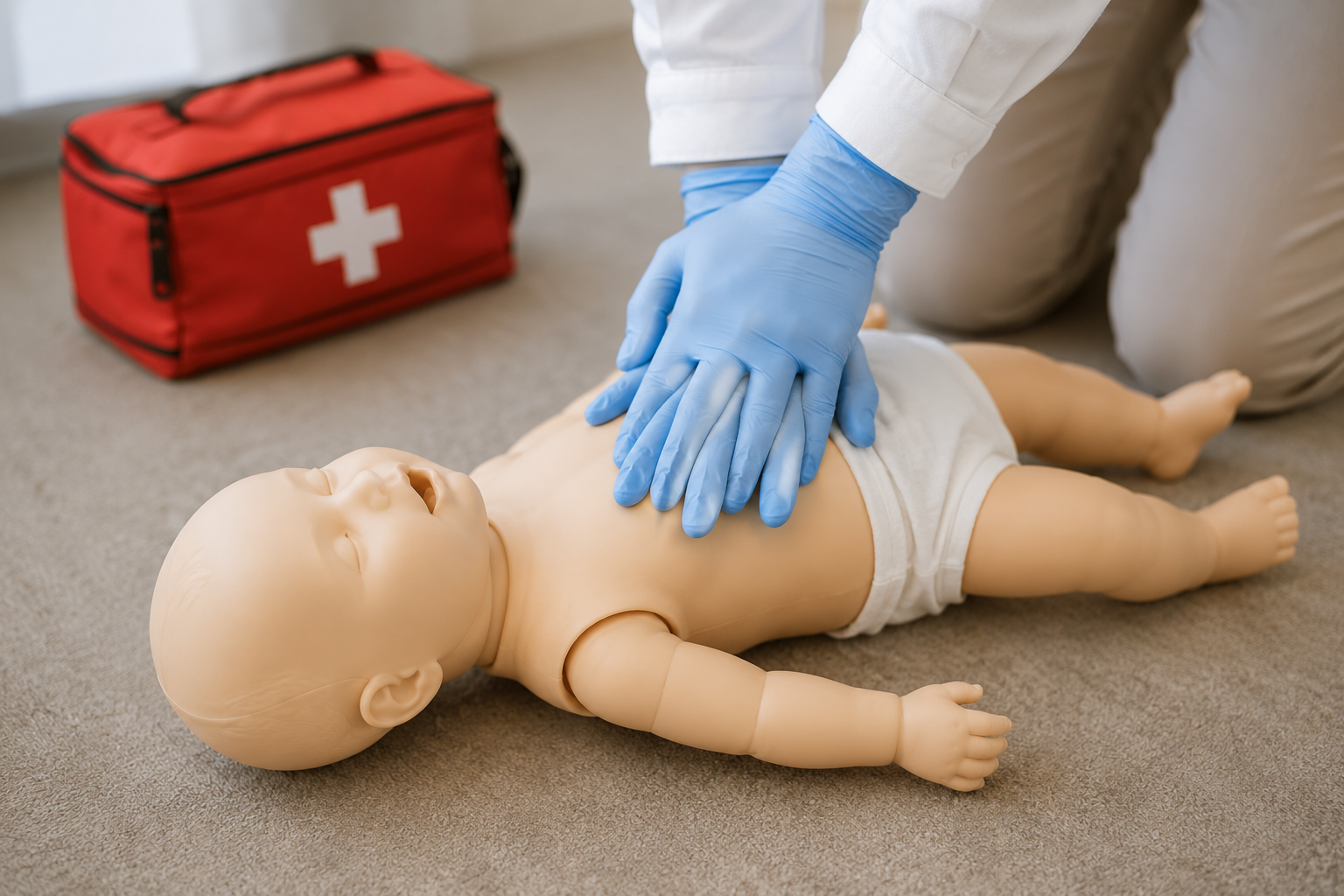
Position your hand
Use the heel of one hand in the center of the chest, just below the nipple line. (The American Heart Association no longer recommends the two-finger technique for lay rescuers.)
Give 30 chest compressions
Push straight down about 1.5 inches (4 cm) — roughly one-third the depth of the chest — at a rate of 100 to 120 compressions per minute. Let the chest fully rise back up between compressions.
Give 2 rescue breaths
Tilt the head back slightly and lift the chin to open the airway, then seal your mouth over your baby’s mouth and nose and give 2 gentle breaths, just enough to see the chest rise.
Continue 30:2 cycles
Keep repeating 30 compressions followed by 2 breaths. Don’t stop until your baby shows signs of life, emergency responders take over, or you’re physically unable to continue.
If Your Baby Is Choking (Different From CPR)
Choking is not the same as cardiac arrest, and it needs a different response. If your baby is coughing forcefully or crying, let them keep coughing — don’t intervene. If they can’t cough, cry, or breathe, per American Red Cross guidance:
- Support your baby face-down along your forearm, head lower than their body, resting on your thigh.
- Give 5 firm back blows between the shoulder blades using the heel of your hand.
- Turn your baby face-up, head still lower than their body, and give 5 chest thrusts (two fingers, center of chest, about 1.5 in deep).
- Repeat 5 back blows and 5 chest thrusts until the object comes out or your baby can cough, cry, or breathe.
- IF YOUR BABY BECOMES UNRESPONSIVE
Lower them to a firm, flat surface and begin CPR starting with chest compressions. If you’re trained to do so, look inside the mouth before giving breaths and only remove an object you can actually see.
Sources
This guide is based on published guidance from the American Heart Association (CPR & First Aid, cpr.heart.org) and the American Red Cross (redcross.org). It’s provided for general education and does not replace certified training, a pediatrician’s advice, or emergency medical services. If you’re facing a real emergency right now, stop reading and call your local emergency number.