
Home / Gear Reviews / Best Baby Monitors
Best Baby Monitors
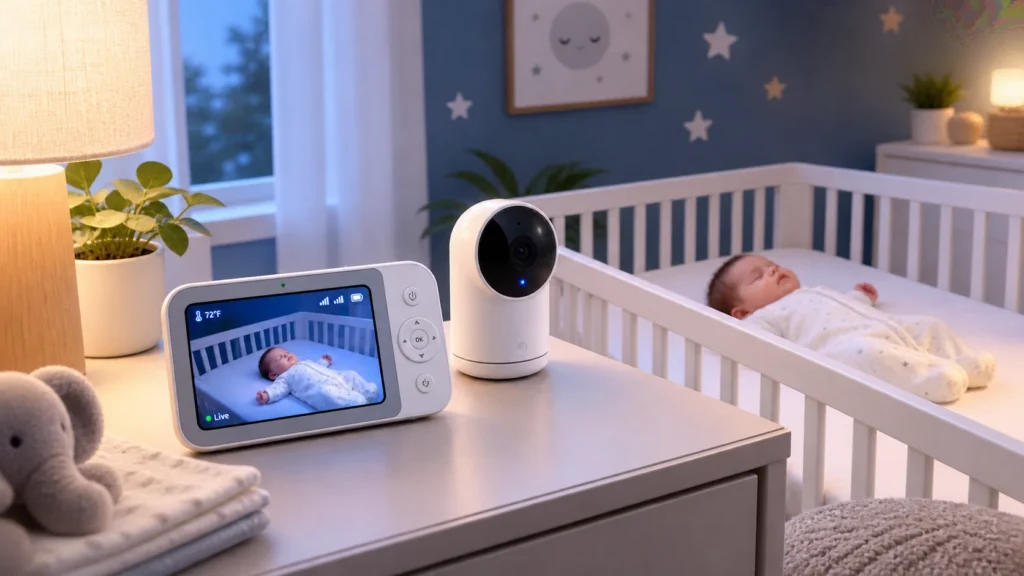
We compared baby monitors using published manufacturer specifications and independent lab test data from BabyGearLab, rather than in-house testing — we’re transparent about that below. This roundup covers video, audio-only, and wearable monitors so you can match the type to what you actually want to know about your baby while they sleep.
Affiliate Disclosure: SafeBabyGear may earn a commission from qualifying purchases made through links on this page, at no additional cost to you. This pilot page does not yet have active purchase links — see the note on each product below. Our recommendations are based on published specifications and independent lab test data, not on which products carry affiliate links.
- WHAT A MONITOR CAN AND CAN'T DO
No consumer baby monitor — video, audio, or wearable — is a substitute for safe sleep practices or caregiver supervision. The AAP notes there’s no evidence that using a monitor decreases the chance of SIDS, and the FDA has stated that no infant monitor has been authorized to prevent SIDS or SUID. For safe sleep setup itself, see our Safe Sleep for Babies and Bassinet Sleep Safety guides — this page is about choosing a monitor, not about sleep safety.
- HOW WE EVALUATED THESE MONITORS
We compared monitor type, price, and independent lab performance data from BabyGearLab’s published testing, along with each manufacturer’s own specifications and, where relevant, FDA clearance status. We have not physically tested these monitors ourselves — every claim below is sourced from those published evaluations and manufacturer documentation, cited at the bottom of this page.
Owlet Dream Duo 2
Type: Video camera + wearable pulse oximeter (Wi-Fi)
Price: Around $400
FDA status: Dream Sock component is FDA-cleared (De Novo, 2023) as an over-the-counter pulse oximeter for healthy infants 1–18 months, 6–30 lbs — the clearance covers measuring pulse rate and oxygen saturation, not preventing or detecting SIDS
Best for: Parents who want vitals tracking in addition to video and are comfortable with a sock-based sensor
Strengths: Good video quality, vitals monitoring backed by an actual FDA clearance (unusual in this category), and strong noise cancellation per BabyGearLab’s testing.
Trade-offs: Stationary (non-panning) camera, the most expensive option in this roundup, and BabyGearLab notes the alert prompts can be easy to miss.
HelloBaby HB6550
Type: Video monitor (non-Wi-Fi, dedicated parent unit)
Price: Around $100
BabyGearLab range score: 8.4/10
Best for: Budget-friendly, plug-and-play video monitoring without an app or home Wi-Fi
Strengths: Easy to set up, no app or account required, budget-friendly for a dedicated video monitor.
Trade-offs: Fewer features than app-connected monitors, and BabyGearLab found night video quality subpar compared to pricier options.
VTech DM1211
Type: Audio-only monitor (non-Wi-Fi, dedicated)
Price: Around $77
BabyGearLab range score: 8.8/10 — the strongest range in this roundup
Best for: Parents who want audio only, especially in larger homes
Strengths: Clear audio, the longest tested range here, and it ships with two parent units.
Trade-offs: BabyGearLab notes limited power-source options for the parent unit.
TimeFlys QQ Portable
Type: Audio-only monitor (non-Wi-Fi)
Price: Around $42
BabyGearLab range score: 5.3/10
Best for: A travel monitor or a lightweight backup unit
Strengths: Budget-friendly, feature-packed for the price, and includes battery backup.
Trade-offs: BabyGearLab rated its range subpar, and some users report audio feedback.
Snuza Hero SE
Type: Wearable movement monitor (clips to diaper)
Price: Around $120
FDA status: Not an FDA-cleared vital-sign monitor — the FDA has warned that most wearable infant monitors, including movement-based ones, lack marketing authorization and are not shown to prevent SIDS
Best for: Parents who specifically want movement-based alerts and understand it is not a medical device or a SIDS-prevention tool
Strengths: Economical relative to other wearables, portable, and vibrates before sounding an audible alarm.
Trade-offs: BabyGearLab notes the potential for false alarms, an alarm audible only in the nursery, and some parents report the clip is uncomfortable for the baby.
Video, Audio, and Wearable Monitors
A video monitor lets you see your baby, which many parents find reassuring, but it’s the most expensive category and typically needs Wi-Fi and an app. An audio-only monitor is simpler, usually cheaper, and can have excellent range, but tells you only what you can hear. Wearable movement or vitals monitors are a distinct category the FDA specifically addresses: as of this writing, Owlet’s Dream Sock is the only one in this roundup with an FDA clearance covering what it measures, and even that clearance doesn’t cover SIDS prevention.
There isn’t a single “best” type — it depends on what you actually want the monitor to tell you, and whether you’re comfortable with a wearable sensor touching your baby overnight.
What to Check Before You Buy
- If you're considering a wearable vitals or movement monitor, check the FDA's device database for its clearance status before assuming it's authorized.
- Video monitors: check the parent unit's screen size, night-vision quality, and whether the app requires an ongoing subscription.
- Audio-only monitors: range is the main spec that matters — check it against your home's actual layout, not just the manufacturer's open-field claim.
- For any monitor with a cord, keep it at least three feet from the crib per CPSC guidance — see our Baby Safety Products Guide for more on monitor cord safety.
Sources
Product specifications and scores referenced in this review come from BabyGearLab’s published baby monitor testing (babygearlab.com). FDA clearance details are drawn from the FDA’s De Novo clearance summary for the Owlet Dream Sock and Owlet’s own published response to the FDA’s infant monitor safety communication. We link to manufacturer product pages where available. This page will be updated with direct purchase links once SafeBabyGear’s affiliate program is active.